
A Gesture Toward Resonance // Andrew Stauffer
An interpretive essay on Woojae Kim’s exhibition, I Hear a Silent Dissonance, written by Andrew Stauffer.
We live in an era of climate-related catastrophes, a mental health crisis, social upheavals, gross wealth inequality, and the seeming loss of culturally shared values. Such ills are mythic in scale, and most of us are all but stunned into a state of paralysis, wanting to act but not knowing how or being unable to act effectively because of the systems in which we are embedded. Given the state of the world, what is the relevance of art? Woojae Kim’s work speaks to the underlying dissonance of this question and offers a hopeful gesture toward resonance in the form of ritual practice.
Ecological philosopher, David Abrams, writes about his time researching magic and medicine in Bali with the family of a young Balian, or magic practitioner. After seeing the Balian’s wife place platters of rice outside of their home and around the compound premises, he inquires about their activities and is told that they are making offerings to the household spirits. He eventually realises that ant trails lead from the rice platters into the forest. As the Balian’s home and surrounding buildings were vulnerable to infestation by the sizeable colony, the rice offerings created a boundary between the human and ant communities and seemed to keep the ants occupied and satisfied.[1] “By honouring this boundary with gifts,” Abrams writes, “the humans apparently hoped to persuade the insects to respect the boundary and not enter the building.”[2] From a modern post-Enlightenment perspective, one could say simply that the fact of the matter is that there are ants that could infest the buildings on the compound, and the rice offerings are sufficient to satiate and avert them. The account of ritual offerings to the household gods is lovely, but it is simply a quaint byproduct of a very obvious need, namely, to deter the ants. One might say the ritual is redundant and could be replaced with a policy of “sustainable pest control.” I am not sure, however, that such a policy would be sufficiently motivating for the people within the culture. Rather, I think the ritual practice is functioning in an important and nuanced way.
This example of the offerings to the household spirits/ants highlights a helpful dissonance between two worldviews. In our post-Enlightenment scientistic (to be distinguished with scientific) worldview, we have countless facts: the main causes of climate change are carbon dioxide and methane. By switching from fossil fuels to renewable energy, we stand to substantially reduce emissions. Limiting global temperature rise to 1.5C would avoid the most damaging effects, and yet current policies place us on a trajectory of an increase of 3.1C by 2100. Making major changes quickly will be good for the world, including humans.[3] We have the facts and minimal action, and yet from the post-Enlightenment perspective, the Balian and his family, while they have effective action, have only myths, which is to say, not facts. (Where truth lies, I leave for another essay.)
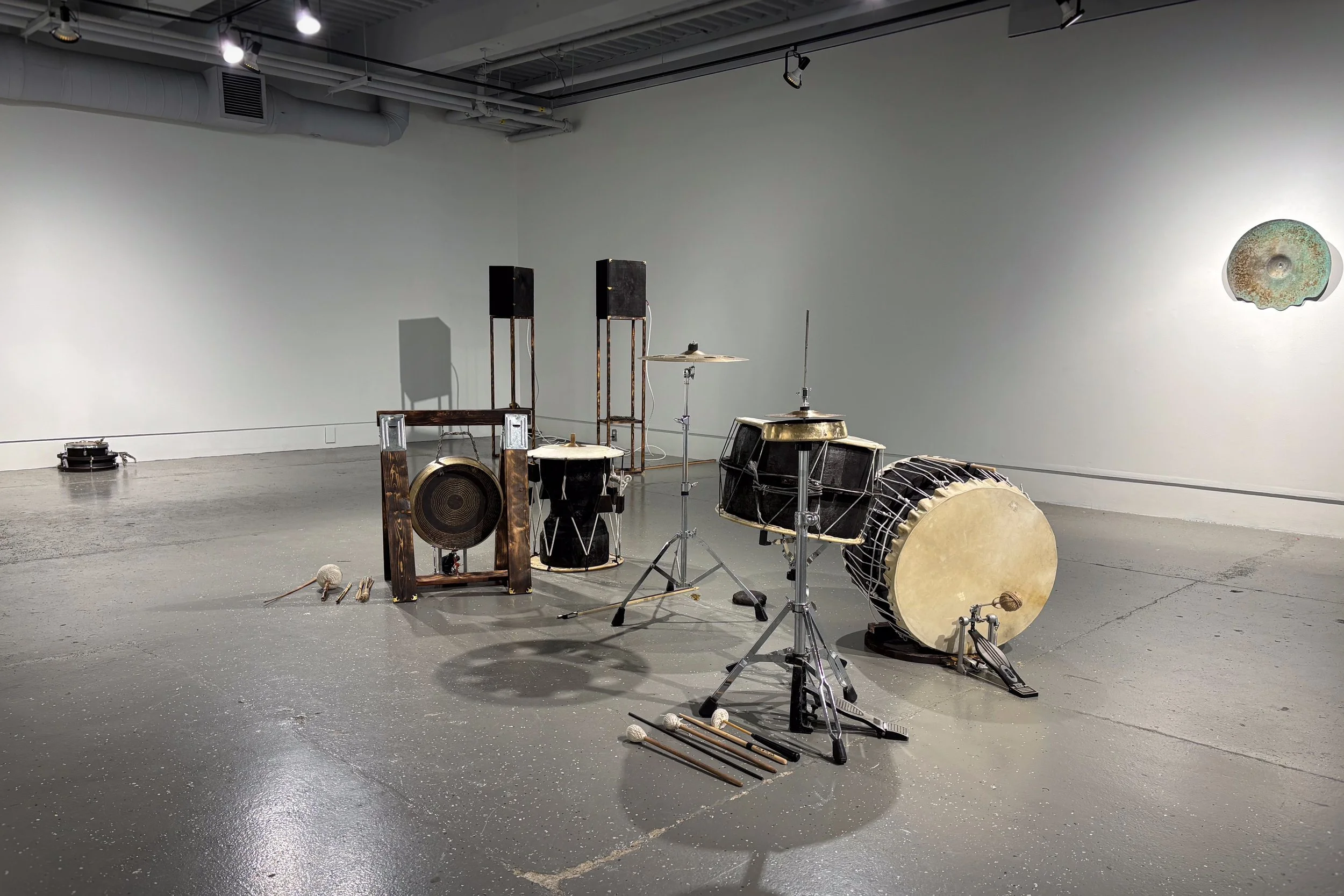
I Hear a Silent Dissonance, Woojae Kim, install view, Main Gallery, 2026.
There is a roundaboutness to this example of ritual that is common to many (or most) rituals, including sporting events in secular contexts, sacred rites in religious contexts, and wedding ceremonies that take place within both contexts. The roundabout way that ritual functions runs contrary to the linear cause-and-effect way of thinking that is the foundation of the modern scientific worldview. Integrally, ritual is not solely cognition-based; it is roundabout in that it can incorporate other elements of embodiment, engaging sight, smell, taste, touch, proprioception, and so on. As varied as rituals may be, they are always embodied in multiple ways, and this is what enables them to function. By working through the body, and not simply through cognitions, ritual can be understood as a sophisticated psychological hack at both the individual and group levels. It enhances affiliation with one's community, strengthens loyalty, nurtures the individual’s connection to a group, and transmits cultural knowledge.[4] To use Kim’s language, there is a technology of ritual that can address a very real relationship between ourselves and the world.[5] Post-enlightenment thinkers assumed that the individual is a rational agent able to make decisions based on enlightened self-interest. Ritual implicitly recognises that this view of the human is inadequate and includes a corrective. It is precisely the roundaboutness apparent in ritual that is essential for meaning-making, an integral task for our times.
Much of how I have described ritual also applies to experiences common in the arts. At its best, art in its varied mediums has the power to bring people together in the same space to share an experience – listening together, breathing together, being surprised together, applauding together, feeling together. Moreover, art has multifaceted layers of meaning that allow for varied perspectives and interpretations to be held simultaneously within one person or between group members. This is another characteristic shared with ritual, which can utilise this multifacetedness to create balance between opposing social and interpersonal forces.[6] Experiences of art create the occasion for meaning-making. Like ritual, art functions in a roundabout way, resisting linear interpretations and justifications and thus opening space for varied experiences and understandings. Donna Tartt writes, “[A]rt cannot be boiled down or reduced to its influences and component parts without falsifying it; its depths, which are nonlinear like dreams and unbound by time, are eerily self-renewing and inexhaustible, and they always have something new to say to us—quite often, things the artist could never have consciously intended.”[7] Anyone whose life has been impacted by aesthetic experiences understands that the meaning gleaned from a song or painting does not work directly. Oftentimes, the experienced meaning has much to do with what the viewer brings to the experience. Past experiences shape current experiences, which in turn shape future experiences in ways that are entirely impossible to trace. (This, alas, is why arts administrators are constantly befuddled at having to provide an account of art’s “impact” on the community.) Understanding art experiences as akin to ritual opens up a new realm of understanding of art’s value.
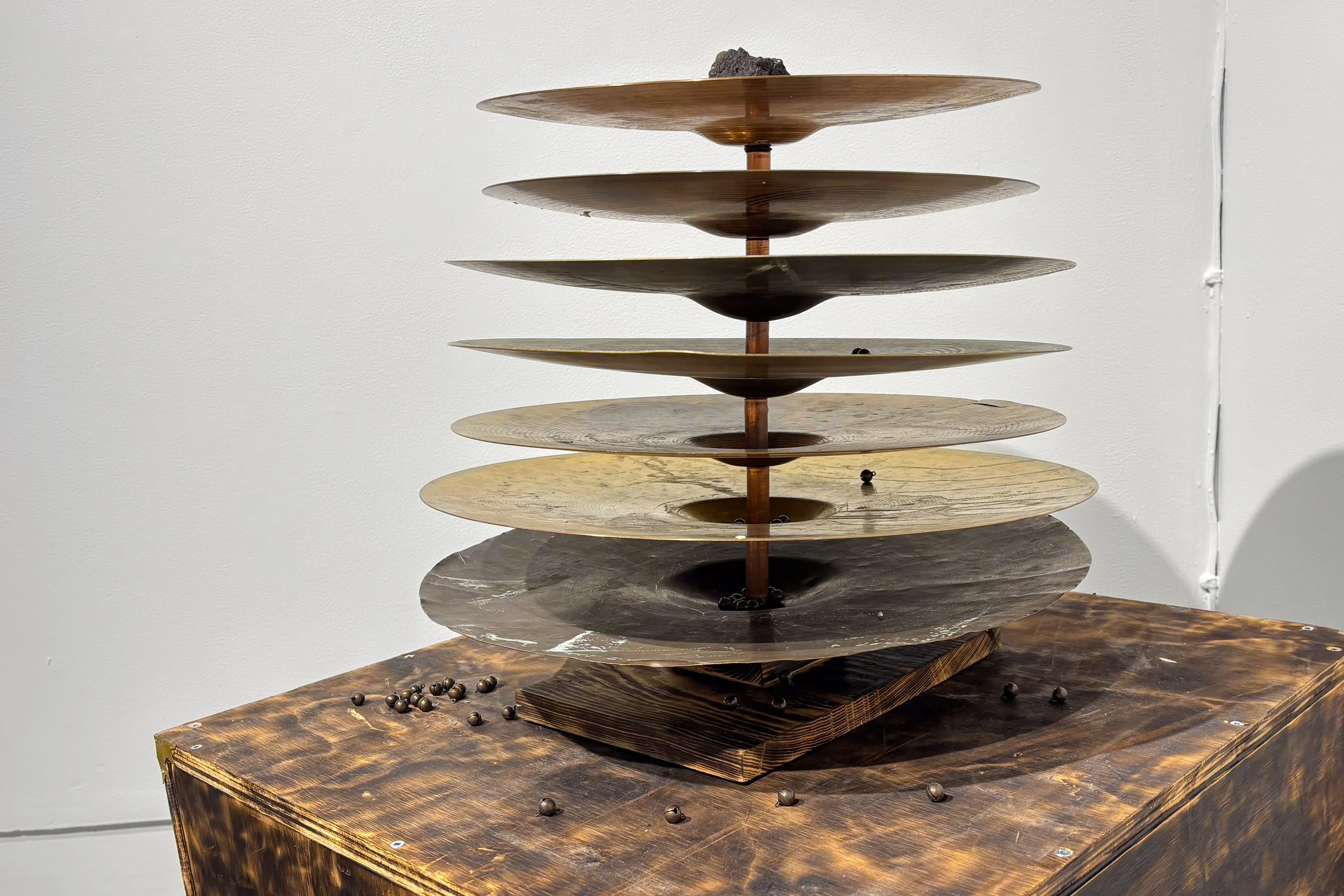
I Hear a Silent Dissonance, Woojae Kim, install view, Main Gallery, 2026.
Kim’s exhibition, I hear a silent dissonance, subtly embraces art as ritual from a broadly spiritual perspective while also contending with art’s relevance. By “spiritual”, I mean any practice, mindset, or approach to life that directs one away from the self (or the ego part of the self) and toward others. With his exhibition, Kim creates the conditions for ritual engagement that are grounded in body and earthly materials. Consider the focus of materiality of the instruments – drums hand-made with animal hides, cymbals bowed with horse-hair bows, the resonant sound that is as much in the listener’s own body as in the external world. This practice of being rooted in one’s body and the world is what facilitates a blurring of the self.
Kim writes about his brain sending electrical signals to contract his muscles, which strike a drum head. The drum’s air vibrates, oscillates his eardrum, and becomes electrical signals that travel to his brain. This account of becoming resonant with another blurs the boundaries between musician and instrument, self and other. Kim’s writing also recalls Merleau-Ponty’s philosophical work, which can be seen as offering a grounded, embodied spirituality. Philosopher, M.C. Dillon, describes Merleau-Ponty’s ontology as the intertwining nature of reality which, like a spider’s web, crosses and turns back in on itself, stating, “this web-matrix, the whole cloth, the flesh, of the world is an interweaving [...] which is always prior to its unraveling in language and thought.”[8] To experience this interweaving involves a practice of attuning to one’s body in order to access experience more fundamental than our rational self, and it enables an openness toward others, human and non-human. This attuning extends beyond other humans or non-human animals. Taking Merleau-Ponty’s perspective further, we can reject the differentiation between the body-subject and world-object in favour of a view of “anonymous perceptual unfolding”, a dehiscence where self and the world are intertwined.[9] This embodied attunement is precisely what Kim offers in his installation insofar as one is willing to engage with the instruments in this way. In short, Kim offers the possibility of a ritual experience of radical decentering of oneself and a corresponding openness to others. This is a hopeful gesture toward resonance that the world needs.
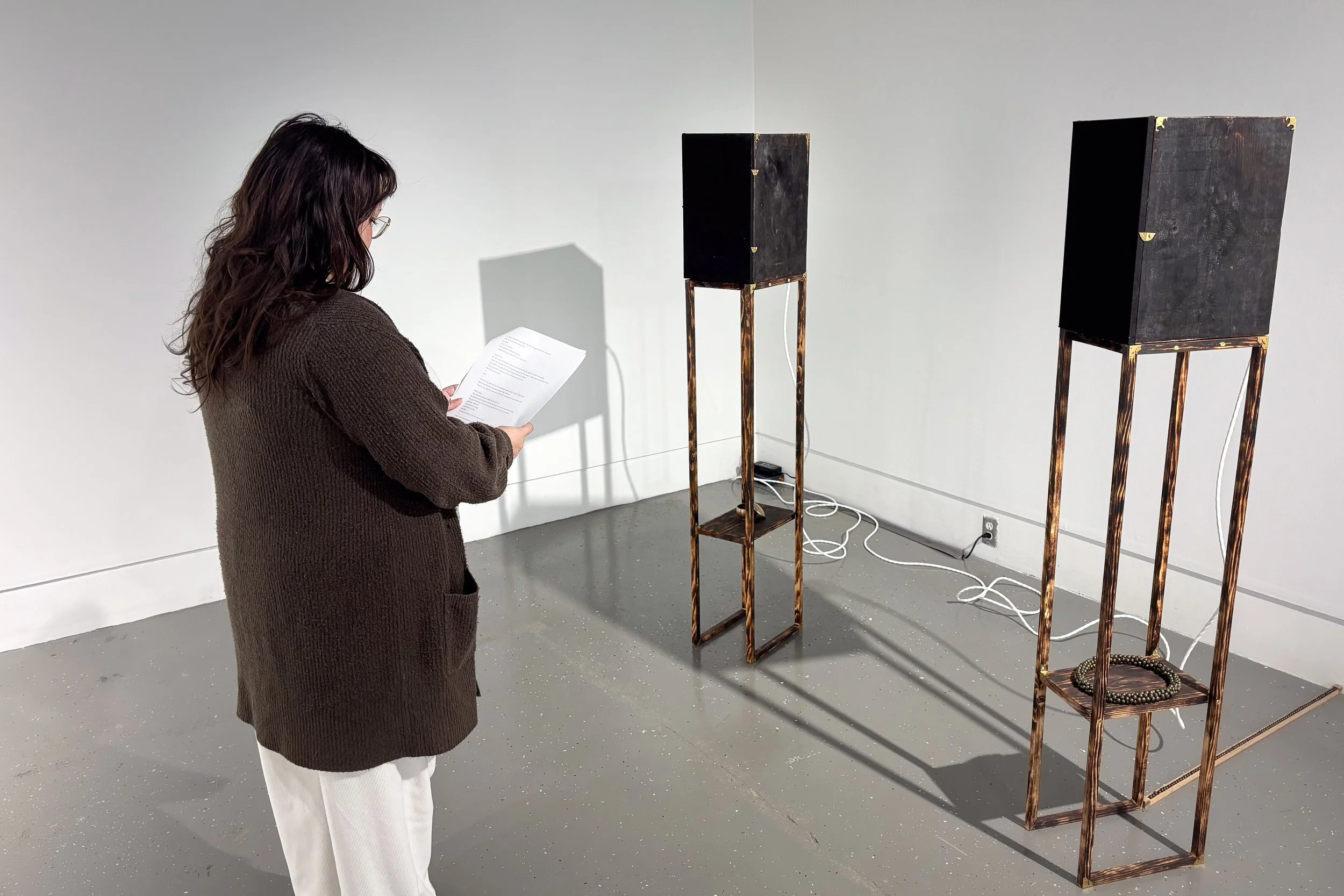
I Hear a Silent Dissonance, Woojae Kim, install view, Main Gallery, 2026.
To conclude, I would like to revisit my initial question of the relevance of art given the state of the world. This question has an underlying assumption that something must function in a linear, direct, and measurable way to be valuable. I have tried to show that art, like ritual, can (and usually does) function in a roundabout way that resists the kind of justification implied in the question. The problem with climate change is not that we do not have the facts or the tools to address it. The problem is that we do not have the political or collective will to use the tools to bring about relevant policy and lifestyle changes. The issues of climate change, the rise of authoritarianism, institutionalised violence around the world, gross wealth inequality, et cetera, can arguably be seen as spiritual crises, where, again, spirituality is understood broadly as that which opens us beyond ourselves, or, more simply, how we relate to each other and the world at a fundamental level. By shifting focus toward shared experiences, embodiment, and the blurring of the self, art experiences such as those created by Woojae Kim can function as a kind of modern ritual that affects us in a very real way, nurturing relationality and strengthening a power that is incommensurable with the powers of exploitative systems, violence, and control.
Andrew Stauffer is a musician, sound artist, and writer, as well as the Theatre Programming Director at the Rotary Centre for the Arts in Kelowna, BC. He holds an M.Div. from Harvard Divinity School, where his research explored the relationship between religion and the arts. He holds an M.A. in philosophy from Ohio University, where he studied ethics and aesthetics.
Notes
David Abrams, The Spell of the Sensuous (Vintage Books, 1996), 11 - 13.
Ibid. 13.
“Climate Action Fast Facts,” United Nations Climate Action, accessed March 7, 2026, https://www.un.org/en/climatechange/science/key-findings.
Nicholas M. Hobson, et al., “The Psychology of Rituals: An Integrative Review and Process-Based Framework,” Personality and Social Psychology Review (2017): 10-14, https://faculty.haas.berkeley.edu/jschroeder/Publications/Hobson%20et%20al%20Psychology%20of%20Rituals.pdf
Conversation with Woojae Kim, February 21, 2026.
Nicholas M. Hobson, et al., 11.
Donna Tartt, “Art and Artifice”, Harper’s Magazine, July 2024, https://harpers.org/archive/2024/07/art-and-artifice-donna-tartt/
M.C. Dillon, Merleau-Ponty’s Ontology (Northwestern University Press, 1988), p. 155
Dillon, 165-166.
Bibliography
Abrams, David. The Spell of the Sensuous. Vintage Books, 1996.
Dillon, M.C. Merleau-Ponty’s Ontology. Northwestern University Press, 1988.
Hobson, Nicholas M.; Schroeder, Juliana; Risen, Jane L.; Xygalatas, Dimitris; and Inzlicht, Michael. “The Psychology of Rituals: An Integrative Review and Process-Based Framework.” Personality and Social Psychology Review, (2017): https://faculty.haas.berkeley.edu/jschroeder/Publications/Hobson%20et%20al%20Psychology%20of%20Rituals.pdf
Tartt, Donna. “Art and Artifice.” Harper’s Magazine, July 2024. https://harpers.org/archive/2024/07/art-and-artifice-donna-tartt/
United Nations Climate Action. “Climate Action Fast Facts.” Accessed March 7, 2026, https://www.un.org/en/climatechange/science/key-findings.