
Untethered Abstraction: Weather Window Echo Hum // Michelle Weinstein
An interpretive essay on Katherine Pickering’s exhibition, Weather, Window, Echo, Hum, written by Michelle Weinstein.
Katherine Pickering’s paintings, two linked bodies of work exhibited together under the title Weather, Window, Echo, Hum, speak through their mesmeric beauty. But this essay is not about the beauty she invokes using the fundamental tools of painting. Substrate, structure, form and color; Pickering also uses these tools to subvert dichotomies, and to complicate them. I will let beauty speak for itself, and focus on the ways in which Pickering complicates the binaries that seem to trail abstract painting.[1] These dualities are enfolded into the history of abstract art, and include Form/Content, General/Specific, The Blur/The Solid (or the line).
The division between form (or subject) and content[2] distinguishes the material artwork from its immaterial meanings. Pickering’s process dissolves any hard distinctions between the two. Her manipulation of materials invokes the Echo of the title; it echoes meanings and creates new reverberations that are simultaneously real and immaterial. For instance, The Blur. According to Rosemary Hawker,
“in painting the blur is able to act as a sign of everything that painting aspires to, both physically as sensual paint and conceptually as the embodiment of the most potent of ideas. The blur shows nothing, represents nothing and has no relationship with the real outside of itself. Yet, paradoxically, the blur is at the same time the most indexical of signs: it registers the purest form of the real, the most fundamental image-making impulse…”[3]
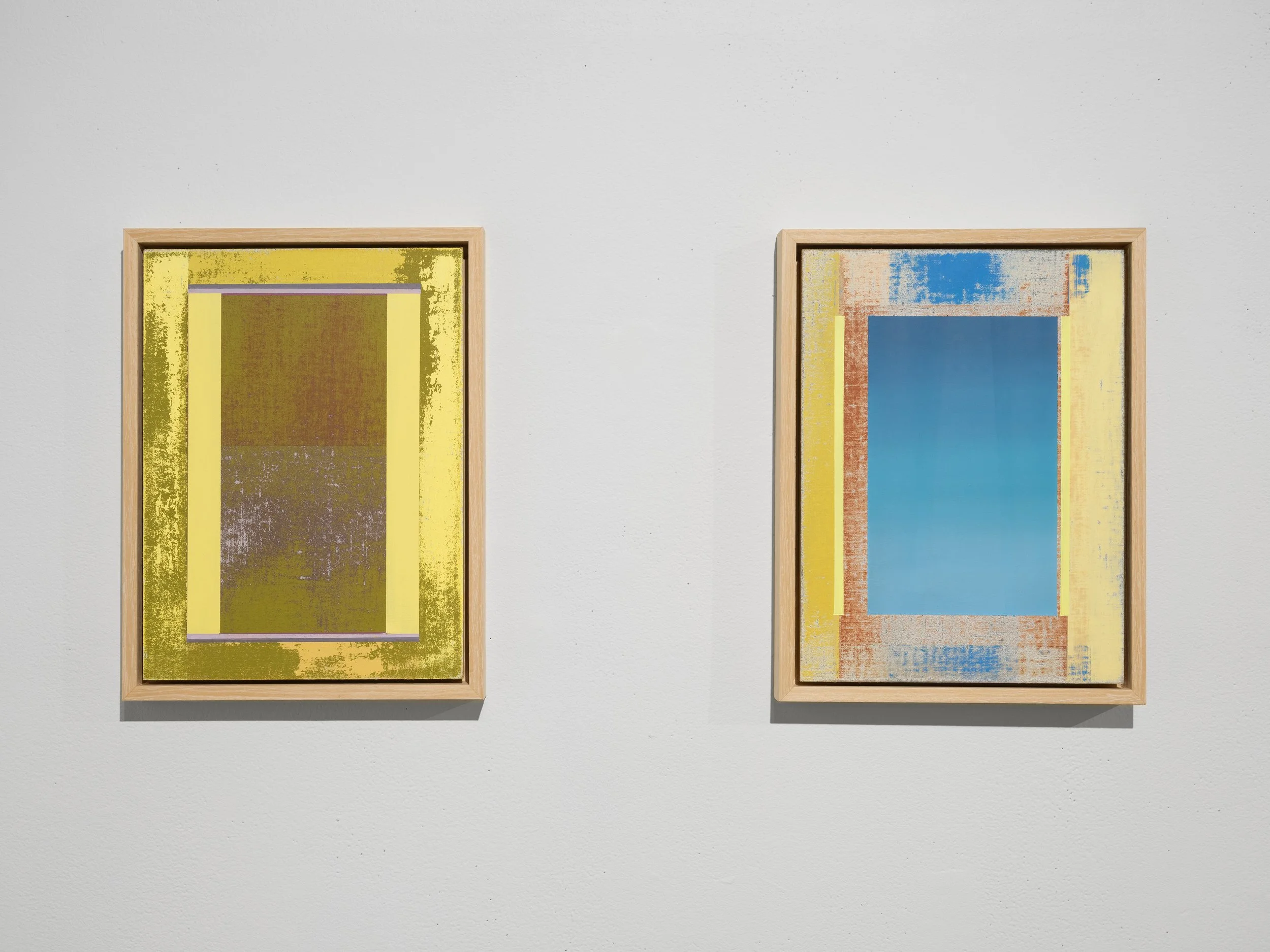
So, Hawker presents the blur as the ultimate self-referring stroke for the painter. However, the blurry sections of the paintings in Pickering’s series Hum are not brushstrokes, they are created through sanding. They are of-and-only themselves, self-referring as image, but due to the process of their creation, link back to the outside world into another form of the real, remembrance. The blurs in Pickering’s Hum paintings are destroyed fields of colours enmeshed into the linen substrate. Only the artist knows the beauty of the original colours. In distinction from the painting x-ray used to discover layers of the past within one artwork, sanding both destroys the previous work, creates the current painting, and reveals the very basis of painting. The act of sanding is generally hidden in the form of layers of labour in sanded gesso. The artist’s use of sanding both destroys and reveals; that which is the past, and that which was once hidden. It is more than metaphorical, it mirrors and embodies the act of remembering. It is an excavation.
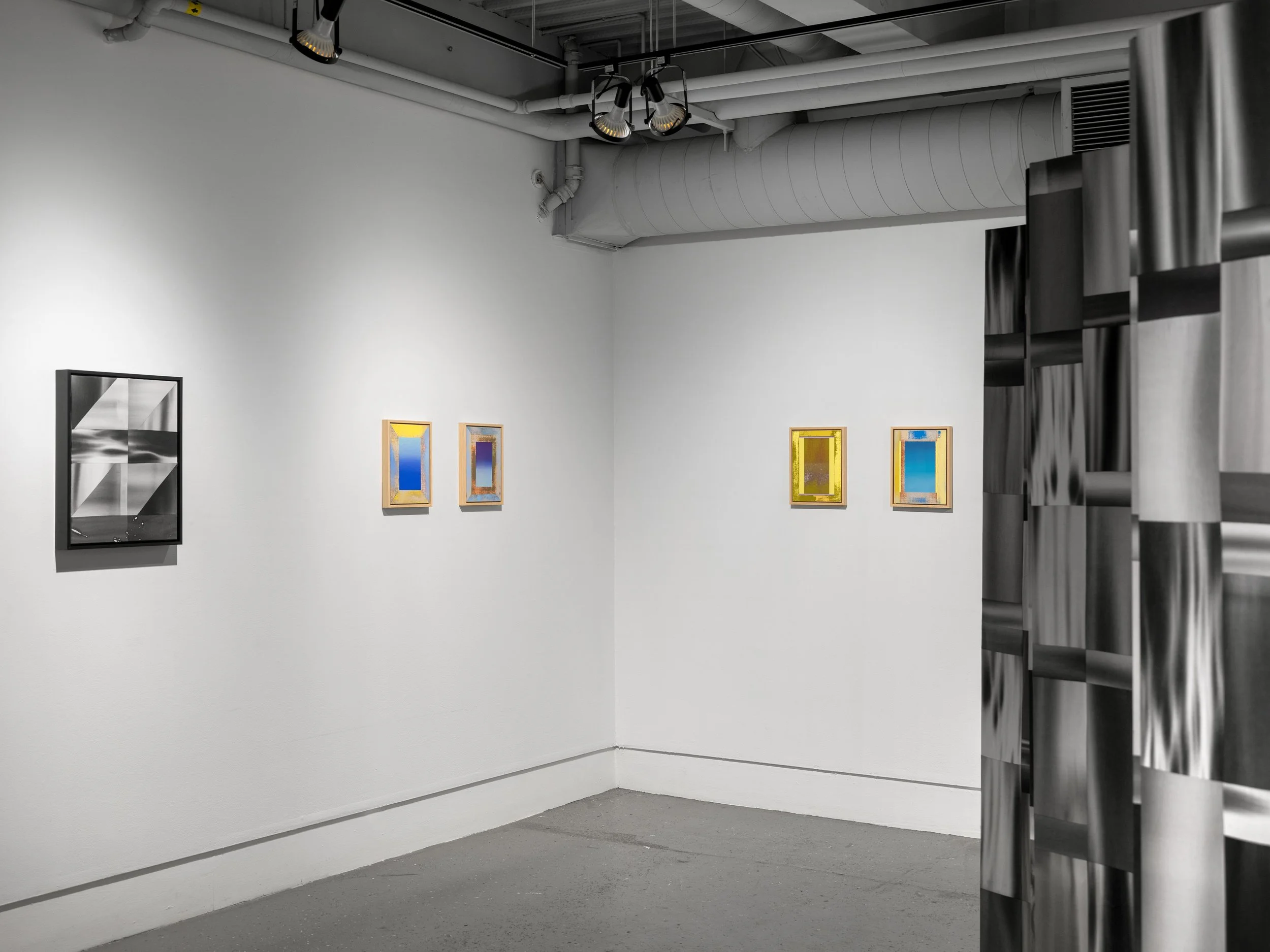
Weather, Window, Echo, Hum, Katherine Pickering, install view, Main Gallery, 2026.
To return to the materiality of the blur; Pickering complicates the blur/solid duality through compositional means. In some cases the colored framing device is the image itself; a colour image, a material presence which blocks off and emphasizes the faded scumble of sanded paint. In other words, the solid color acts as a frame to the blurred. That which pops as the subject, creating its own space, falls back as a framing device, creating tension, a formal pirouette around any simplistic notion of subject/object. (See Frame).
In other works colour is an action against a “surface that holds a kind of visual static,”[4] in the artist’s own words. (See Stitch) Or again, an optical illusion of space is created through colour that frames while it pops with brightness. Impossible seams that are directional shifts of texture through a haze, create forms that seem to fold in space, and recall the quilting memories. (See Fold) The paintings subvert the expected hierarchy of color as field, and ground. The painting Window has the most unexpected non-central hub. The centre portion of the painting is also a blur, this time a solid colour field of graduated colour; blue to brown. The colour is dense, vivid, material. The visual centre of the painting is also the darkest portion. As the eye rests on this nebulous darkness perched between brown and blue, the surrounding sanded frame starts to hover in space, its bright light blur predominates. There is no true locus to this seemingly straightforward painting. Instead a paradoxical space is created, a window where the frames are a visual focus as irresistible as the intense colour-materiality of the true centre.[5]
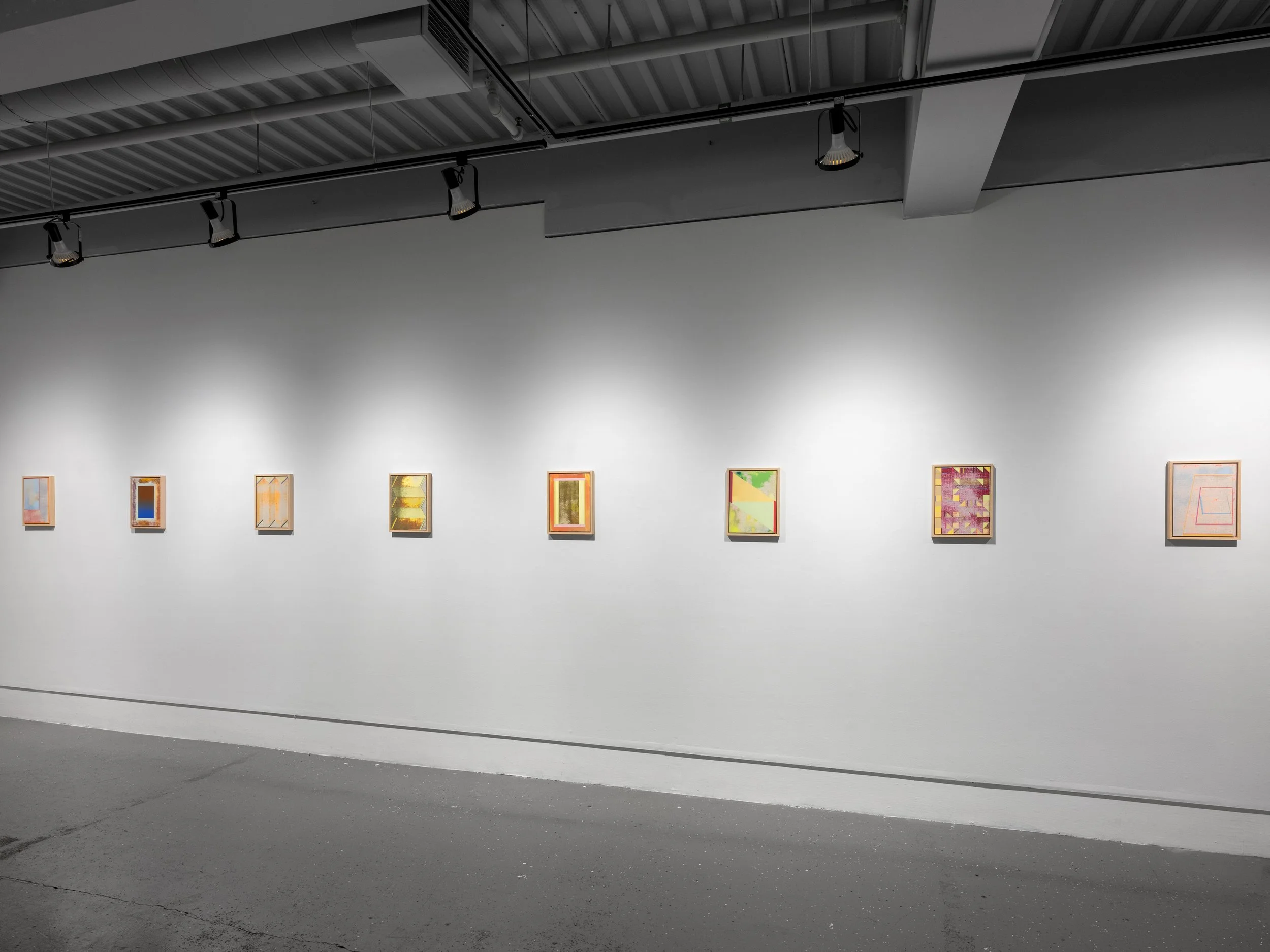
Weather, Window, Echo, Hum, Katherine Pickering, install view, Main Gallery, 2026.
Early trailblazer of abstraction, Wassily Kandinsky (1866-1944) set up a duality between the specific and the general (or definite and indefinite), using colour as an example. He expressed this dichotomy as the difference between imagining a colour, as opposed to the (necessarily) specific colour as it exists in a painting. The idea of red is infinite, boundaryless, but without resonance because it is indefinite. It is only the specific corporeal incarnation of a particular red in a certain form, with boundaries, that a definite colour can resound as an essential aspect of an artwork. He distinguishes the red of the mind, and that of the eye.[6] I would extend this thesis into the visual reality of “the seam,” as displayed in Pickering’s paintings. By exhibiting these two bodies of work together, Katherine Pickering has found a way to disrupt the logic of the mind/eye duality. The various seams of the paintings, taken together evoke the mind’s ideal seam, yet tied to the real, as it arose from the eye. The sewn seam, painted seam of colour-line, the seam of a quilt, a seam in the land; these inter-tangle through evocation to create a flexible, tactile idea of the seam, intrinsically connected to the visual forms that elicited them.
Because of their beauty, it is easy to overlook some other thrilling aspects of Pickering’s work. Through subtlety, process and transformation of all materials, she has created an abstraction where memory reverberates, dualities are dashed, and the ideal and the real enmesh into the artistic experience.
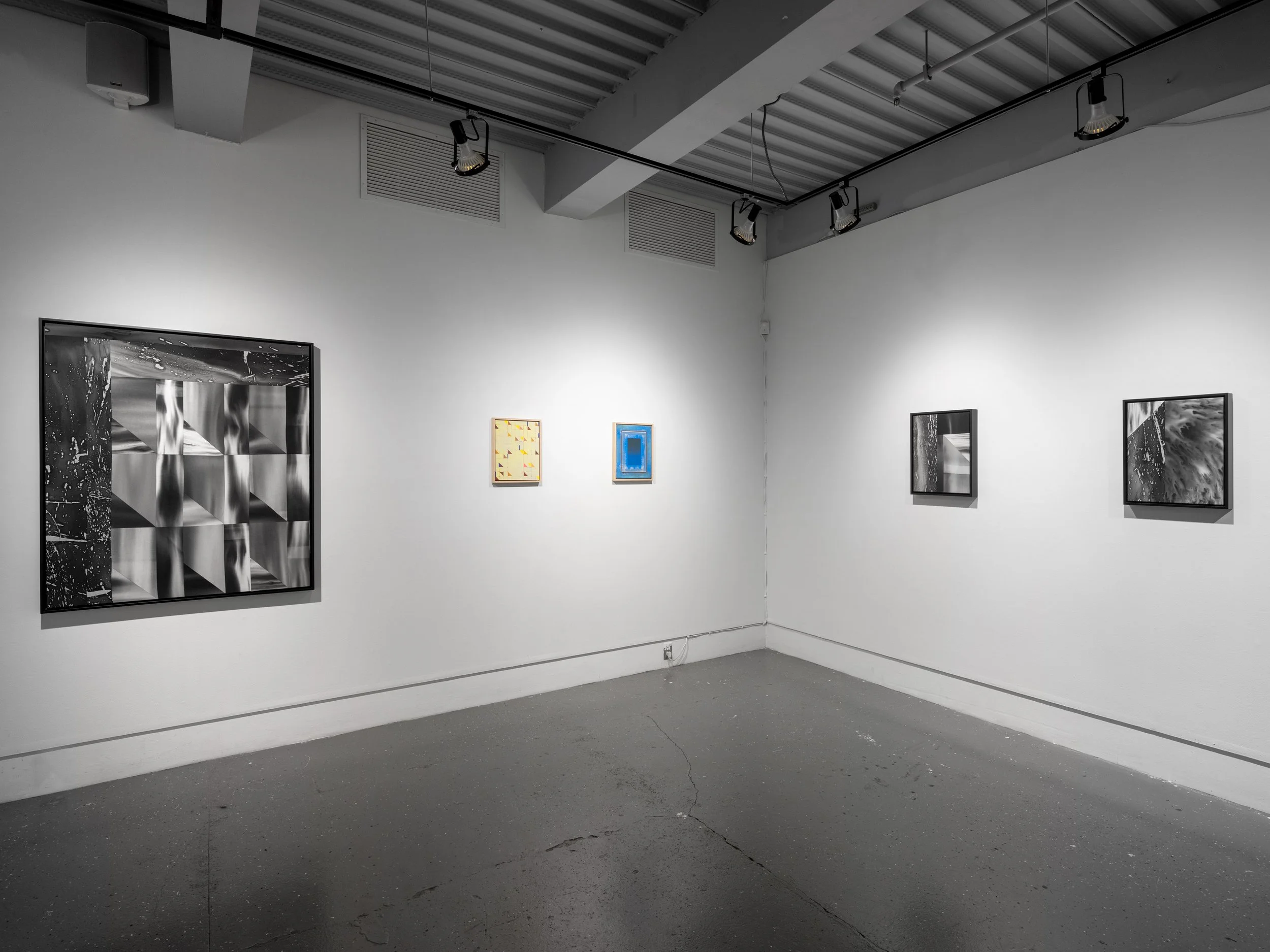
Weather, Window, Echo, Hum, Katherine Pickering, install view, Main Gallery, 2026.
Michelle Weinstein is a writer and an artist whose material artworks and immaterial art-events investigate temporality, and its relationship to consciousness. She earned her BFA (2002) at Maine College of Art, and Yale University/Norfolk School of Art, and her MFA (2015) from University of British Columbia. She was awarded a SSHRC (2014) by the Canadian government in order to support her studies. Her work has been exhibited nationally and internationally since 2002, including solo exhibitions at SmackMellon in Brooklyn, NorthView Gallery in Portland OR, and the Gam Gallery in Vancouver BC.
Weinstein’s most recent large-scale artwork, was a one-night public art event in May 2019 at the Ladner Clocktower and its surrounding sunken garden, on UBC campus in Vancouver. The work was created with the sunset, carillon music, theatrical players, Small-scale sculpture, architecture, the public, and the landscape. She hopes to create another event in the near future.Weinstein has been a guest speaker at both campuses of UBC. She lives and works “at large”.
Read other essays by Michelle here:
Notes
Hoptman, Laura, “Tomma Abts: Art for an Anxious Time,” pgs. 10-15, In Tomma Abts auth. Bruce Hainley,Laura Hoptman, and Jan Verwoert (Phaidon Press, 2008.)
The form/content split was taught to me thoroughly throughout secondary and undergraduate program. I think it is still common knowledge, but not sure if it is still in the painter’s curriculum. The critic Clement Greenberg essentially collapsed this binary when he championed artists such as Frank Stella, relating painting to the object, debatably into the realm of sculpture.
Hawker, Rosemary. 2007. “Painting Over Photography: Questions Of Medium In Richter’s Overpaintings.” Australian and New Zealand Journal of Art 8 (1): 42–59.
doi:10.1080/14434318.2007.11432779.
Katherine Pickering, email message to author, December 10 and December 18, 2025. The quotation and background of the paintings came from these emails.
For further reading see: Arnheim, Rudolf, The Power of the Center: A study of composition in the visual arts: The new version. (University of California Press, 1988.)
Kandinsky, Wassily, Concerning the Spiritual in Art. trans. M.T.H. Sadler (Dover, 1977.orig. 1914) p. 28