suntraces: the code we carry // Aly K. Benson
An interpretive essay on Krystle Silverfox'’s exhibition, low-rez, written by Aly K. Benson.
Light memory is an inheritance, for us as a peoples, and for the land and space we revolve in. It has been passed down over the billions of years of the natural development of our world, or considered over decades of creation through new technological applications. Regardless of lightways' origins, they can never switch on and off - they are ingrained in our daily life, and trickle through our bloodlines as swiftly as rivers embed themselves into the shorelines of the land. Light leaves traces just as stories hold our histories; light, like storytelling, is intangible yet integral to our beings; it is what makes us, us. Both disperse at their own pace, releasing a pulse that becomes an integral lifeline in how we understand the reality humans have built. From this, it's essential to ask: is it damaging or progress when we re-engineer, re-construct, and manipulate the elements we are responsible for building?
Light is arguably the most significant shaping force we observe and are influenced by on a daily basis. And though, yes, our world and lives would not exist without our sun and its light, with technological advancements, we can disrupt our natural path of development and evolution. We as humans all persistently leave evidence of our impact, and mix like words in a well-told story - this is what the themes in Selkirk First Nations artist Krystle Silverfox's installations flicker through. Specifically, her works Connections and Raven <lite> in the exhibition Low-Rez.
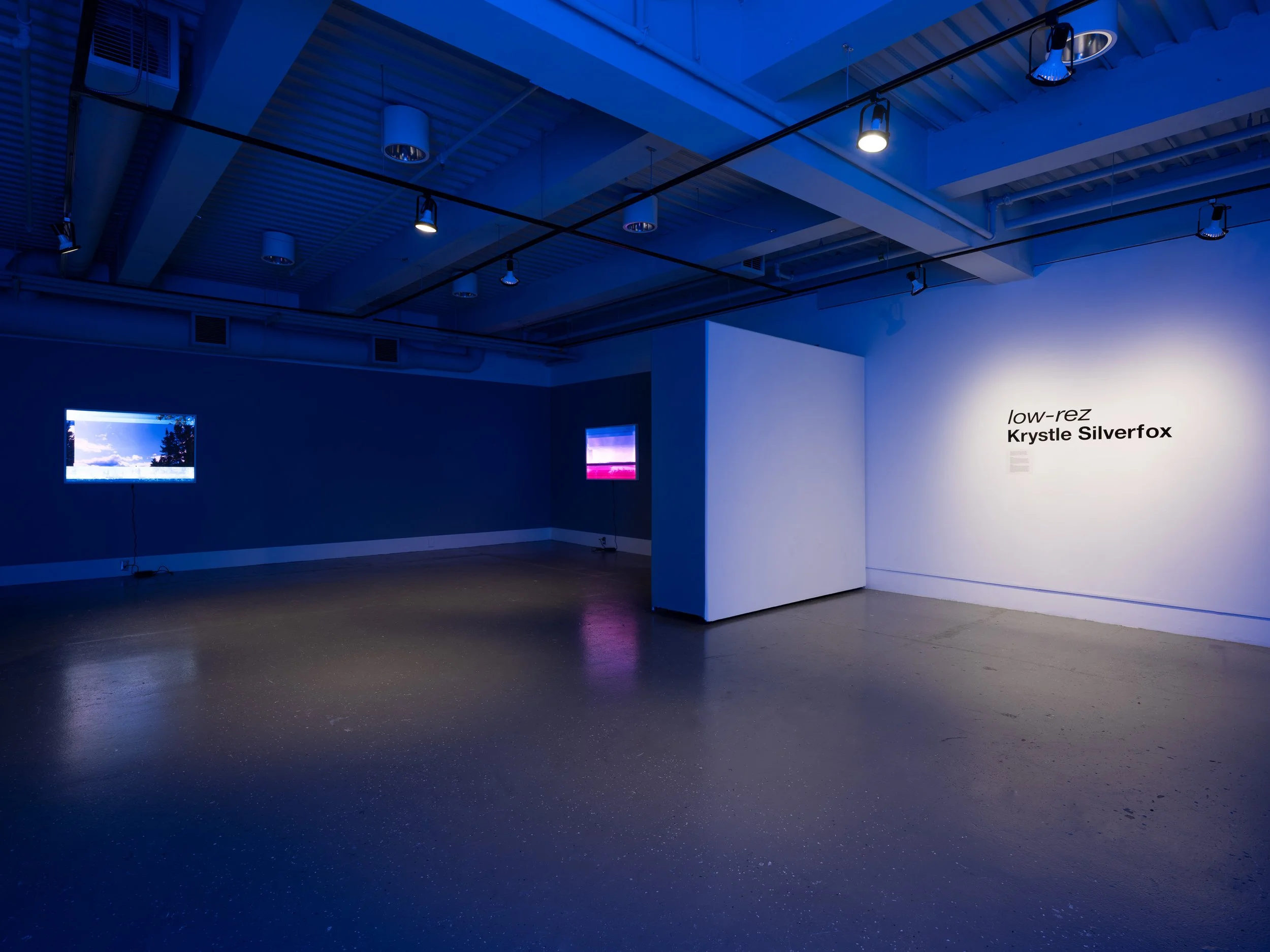
low-rez, installation view, Main Gallery, 2025.
A Materialistic Future Full Of Storytellers
Materialism rules our world; there's no doubt about that. But it comes in a way that reveals an undeniable amount of future potential; it's challenging to navigate the constant juxtaposition we live in.
We have all been there, so enveloped in the reliance and falling down the rabbit hole of technology. It is moments when you are so tightly engaged with the screen in your hands, you look up, and the clear blue skies have suddenly turned grey. You may not give it a second thought, and the focus of your eyes automatically lead back to the distraction in your hands. Your attention is drawn away later from the heavy pattering of raindrops against your window. And in that moment, you question "how long have I really been focusing here?" and the immediate rush for the need of fresh air washes over you.
The contrast between our consumption of light and the fuel it provides our world and all that lives in it, shaping our minds and lives heavily through technology. However, these technologies can also ground us. After all, they host and preserve our memories and stories, allowing us as aboriginal peoples to learn and practice our traditions in unimaginable ways. Silverfox uses this concept throughout the exhibition as a means to decolonize light as a resource, a tool to rethink how we present an encapsulation of the beauty in this contrast, rather than what could be considered the surface-level sorrow. This is Indigenous futurism at its core - re-evaluation of how the synthetic and the living coincide, a new sunrise horizon for our peoples, our children to beam brightly alongside.
It's important at this point to explicitly address the sombre, destructive reliance on technology and light. There can be great difficulty in recognizing the altered rhythms we have built. Take sleep cycles influenced by the caffeine version of light, such as blue light, and, centuries before this, fire-fueled light, allowing us to redefine a sleep schedule. Consider the reliance on the skies that once determined so much - now technology surpasses what we thought was possible with the naked eye. However, this means we have lost the ability to track the heavens as easily as we once did.
Silverfox spoke to this reality, contemplating how wifi and the internet have overruled densely populated areas, leaving many rural communities, like her own, without regular or strong access to the "standard way of living." This raises questions about priority and basic living needs, especially when reservations and Indigenous bands across Canada receive wifi before water treatment initiatives. Overall, it's difficult not to notice the contradictions woven into the way we live and how much is ruled by technology - but it's here, Silverfox's creations present how this duality can be utilized and allow viewers of her artistic practice to consider the split in our dichotomy.
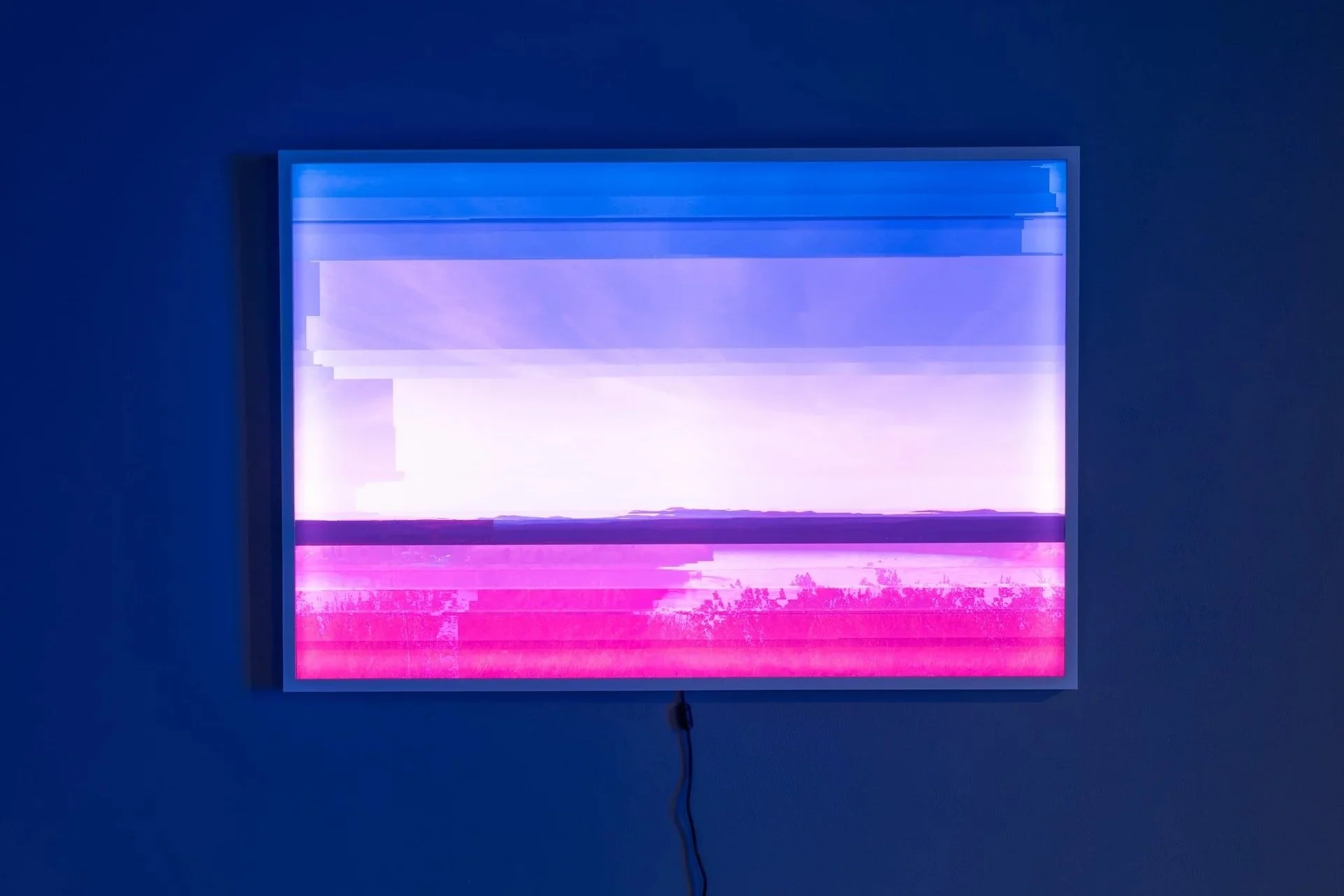
Connections, Main Gallery, 2025.
Connections (& The Frequencies We Follow)
Silverfox's work Connections consists of two photographs (on digital screens) of the Kwanlin Dün and Ta'an Kwach'an (Whitehorse, Yukon) landscapes. Though these images are distorted, this intentional disruption creates an enveloping draw-in that invites observers to analyze the artist's intentions further. The abrupt removal of code, the practice of using Wordpad rather than WordPress, and the deletion of data to display "glitches" in the form of colour shifts reflect the actions of colonial erasure. Furthermore, this work is a metaphor for the intrusion and displacement found in actions of assimilation and the extreme change of culture indigenous people have endured as a result of residential schools and the 60s scoop. Here, the artist takes on the role of a tactile agent of change, positioning her self-determination as an act of reclamation.
When considering the lands where Silverfox currently resides, in Whitehorse, Yukon, many elements of reference can also be found in this work; many of which rely on the give-and-take between technology, inevitability, reliance, admiration, and resistance. These are what the artist once referred to as "real northern disruptions," where amenities like ATMs or stable service connections are lacking. Viewers are invited to contemplate the themes of affordability and the accessibility of technology, with contemplations of distortion and survival coexisting. And the work loudly splotlights the ever-shifting ideology that links us back to the original juxtaposition we revolve around every day: is technology good, or bad? And, could we continue to thrive off of light sources we’ve manipulated?
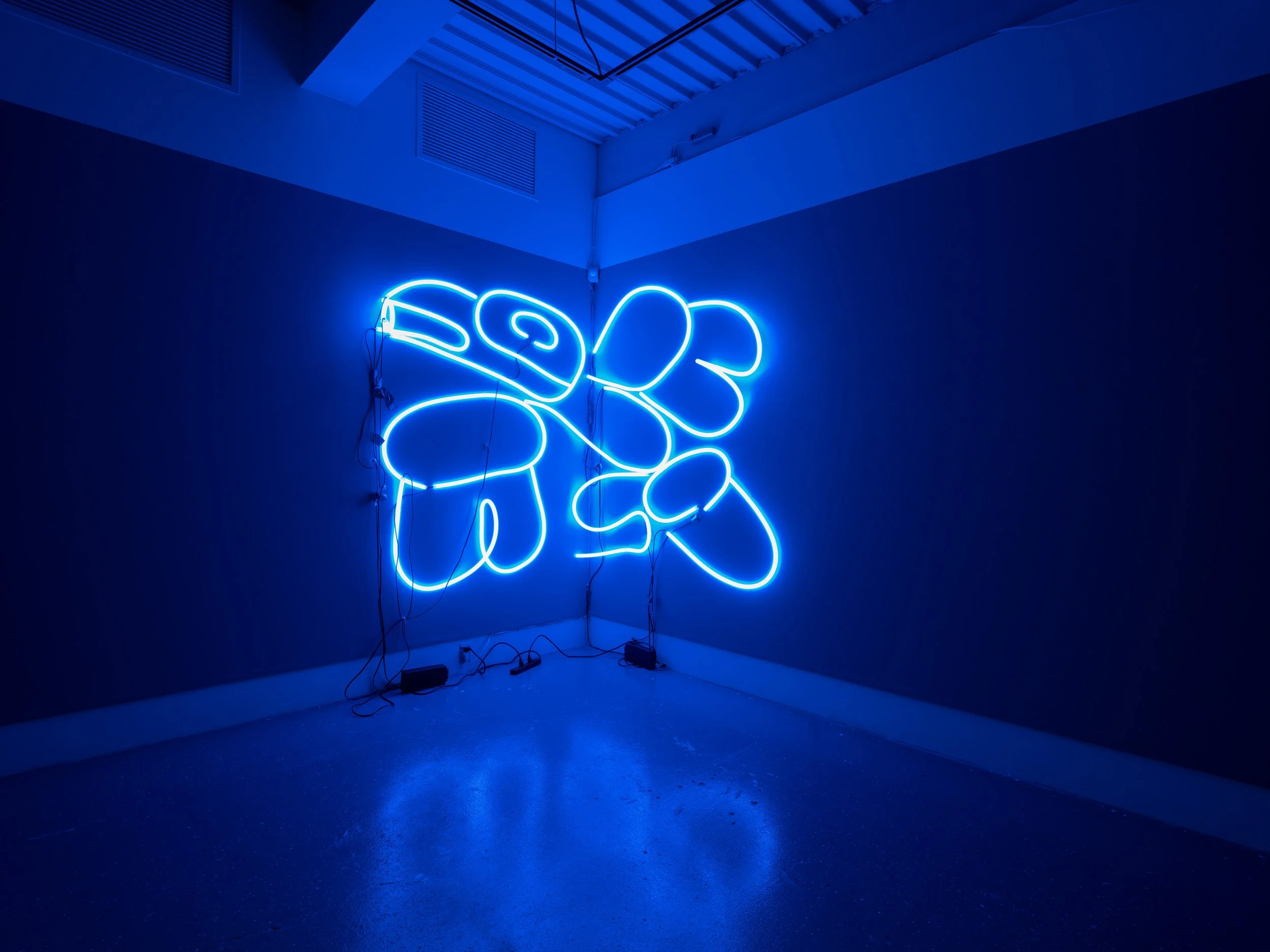
Raven <lite>, Main Gallery, 2025.
Creation of Raven <lite>
One of the most significant actions Silverfox takes as an artist is to highlight the endless possibilities of combining sculpture with light-driven technologies. Raven <lite> is an anamorphic LED-tubed structure designed to be viewed from only one angle. As visitors of the exhibition move throughout the gallery space, the form of the Raven alters. With immediate reference to the creation story of Raven stealing light through its forward-facing depiction, the intended angle of viewing this piece reflects the shapeshifting nature of the Raven. The sculpture is meant to adapt to any space it's placed in, similarly to Indigenous peoples' ability to adapt to societal shifts, particularly in light of technological advances and colonial impacts.
When compared to its exhibit partner, Connections, Raven <lite> takes a more playful approach to indigenous futurism and the subject of light memory. Not only is it brightly eye-catching and the centrepiece of Low-Rez, but the very act of making a direct reference to the heritage of storytelling brings a youthful essence to the space. The beaming blues of this work, paired with dimmed lights and negative space, draw visitors into its mesmerizing construction.
The Endurance of Memory & Land
The core of these works revolves around light as an affirmation that the ancestral and technological can coincide. Silverfox's methods demonstrate how stories can carry our histories and lay the groundwork for future progress. Both the cultural and material aspects of her approach prepare us to reflect on how memory and land work in tandem, as well as on how the synthetic and the living can remain in constant relation.
Connections leans into the complex modernity we navigate today, positioning technology as an inevitable yet critiqued lifeline for a society built on colonial damage and technological inequity. As for Raven <lite>, the sculptural work speaks to contemporary applications of tradition, offering a less invasive, continuity-focused approach.
Together, these works form a narrative arc between fracture and reclamation, leading into re-emergence - all of which are held within Indigenous futurism as the framework that renders these contradictions meaningful rather than destructive, and exude an immense appreciation for the notion that there was much before us, and much that will outlast us. Silverfox's creations are reminders to us all that man-made manipulation has shaped our world, and that can be a terrifying thought to delve into. At the same time, we are presented with a heavy reminder that it all still stems from Mother Earth, and these elements, these constructions of Her fragments, are all gifts of light that now allow us to keep our memories living.
Aly K. Benson (AKB) is a biracial Cree writer, strategist, and multimedia artist currently residing on the ancestral land of the Syilx/Okanagan peoples. With a Bachelor of Arts in Western Art History and a minor in Anthropology, AKB has published over 40 works in recent years. They were also exhibited at the Kelowna Community Theatre (April-May 2024) with their display of “Our Cabin In The Woods” and made the shortlist for the 2024 UBC Short Story Contest.
Read other essays by Aly here: