
the air in our lungs & the insects that walk in Her grass // Aly K. Benson
An interpretive essay on Lara Felsing’s exhibition, Shallow Breaths, written by Aly K. Benson.
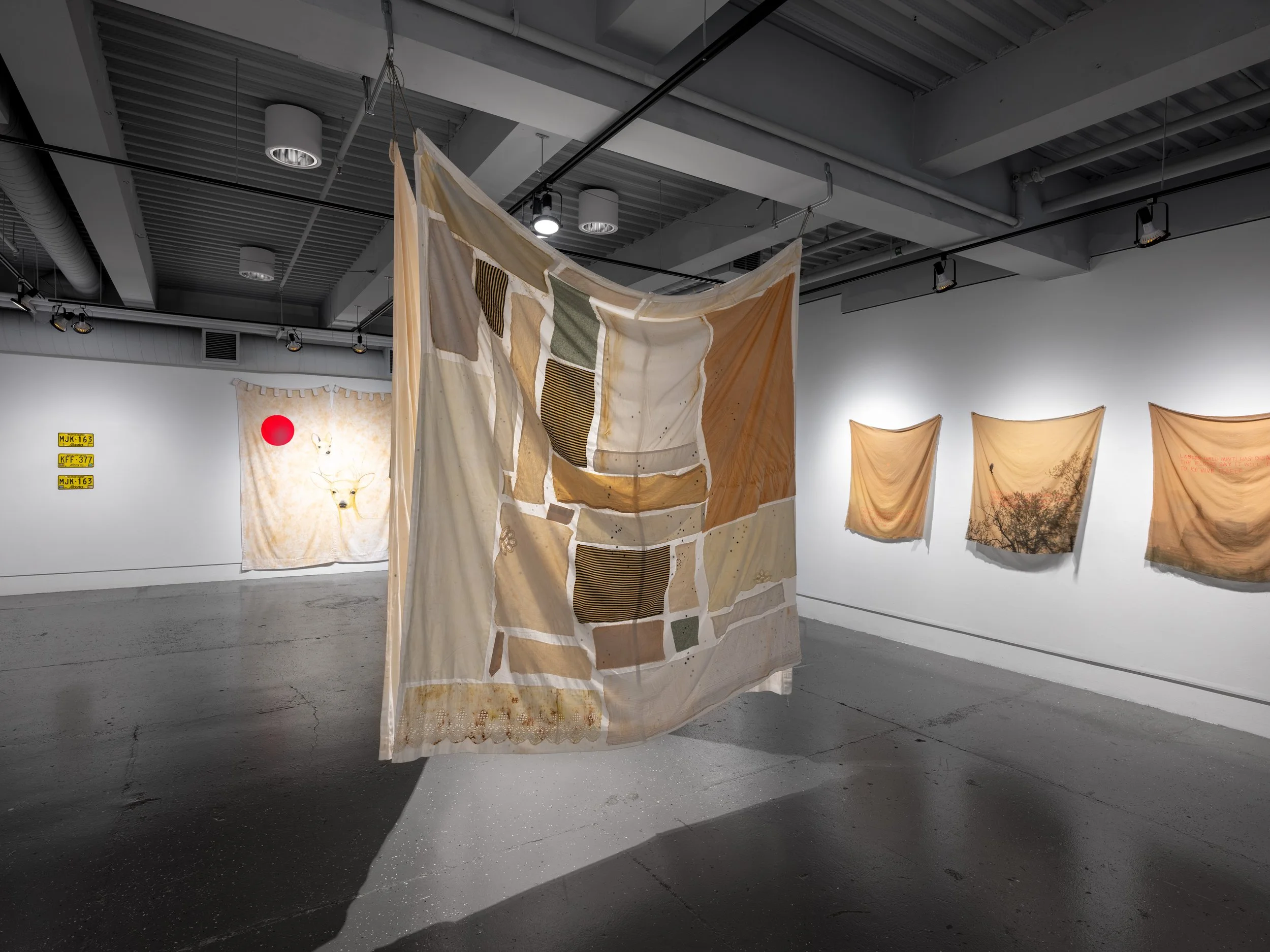
Shallow Breaths, Lara Felsing, install view, Main Gallery, 2026.
Understanding the Earth begins with traces of Her pressed into our palms, and the grass leaves stains on the skin of our knees, after our first steps turn into a tumble. In our earliest years, we learn to walk on the ground before ever knowing what it means to be held by it. It’s not until our brains are engulfed by a vocabulary gifted to us by our elders that we can eventually embrace our responsibility to understand it. To care for it - for Her. In growing, endlessly, we learn how our skin can carry the scent of the land, and the way our senses hold memory, carried throughout the entirety of our lives. As we age, our individual worlds expand, and communal teachings open our minds to new meanings. We are taught that with every summer, growing networks span beneath our feet, dirt turns into greens that feed our stomachs, and the fuel we live on for the remainder of the year is renewed. But with every passing year, our growing realization of the world's abundance is tempered by the hard lessons of renewal.
Our ancestors thrived in a relationship of admiration and appreciation with the land, and this is not lost. In our current ecological state, it’s important to delve beyond the surface and recognize reminders to see what reciprocity asks of us now. In reflecting, the land becomes more than an idea, more than an infant's initial impact; it becomes a teacher, a witness. This relation is what Cree-Métis artist Lara Felsing explores in her exhibition, Shallow Breaths. Her artworks express to and with us that there is, and always will be, a balance (even when intentions can be displaced). Here, Lara urges us to hold nature's beauty, embrace our collective grief, and seek the answers to what Mother Earth is asking of us.
bugs, feathers, sticks and stones
How often do you think of insects? How often do you all really interact with them? Someone living on the 7th floor in a city centre of a million people for the last five years may not keep the importance of little creatures in our vast biome at the forefront of their mind. It's not an extreme assumption that finding them in their space would be an annoyance. The fruit flies, the random black fly, find their buzzing way into our kitchen. For the 7th-floor person, it may not be a priority to think of the impact of the reliance we have on these little beings - their priorities may begin to mirror the lifestyle of the surrounding city, with concrete walls blocking out a truereality beyond. Like how farmers carry knowledge of how a booming grasshopper population can signal a drought season. Or how, after wildfires in Western Canada, beetles are often among the first living things to begin restoring the land to Her homeostasis.
However, a mother who tends a garden and teaches her children about all the possibilities of plants is accustomed to the little beings’ presence. This family, regardless of lineage or racial ties, is practicing the longest form of human tradition - the embraced kinship with Earth’s entirety. This mother would take the time and care to relocate a spider from the corner of her kitchen to a yarrow petal or the leaves of a strawberry plant, knowing it could thrive there with an abundance of food and protection. This is not merely empathy for living beings, but rather the ownership of the responsibility of a role in nature's cycle. When comparing these two situations, it would almost be cliché to say the person living in a concrete jungle is taking Earth's creations for granted. But that is not really what is happening on a larger scale with all things considered. It is about what our minds and routines are capable of absorbing,
processing, and prioritizing; it is how easily humans can and have become normalized to disconnection. And when Mother Nature becomes too visible to ignore, we receive brutal reminders with increasing frequency, the longer we attempt to keep our blinders on.
Such understandings have been passed down through generations of Lara’s family, carried in her heritage, and woven into her gathered media. She uses methodology, subject matter, and ancestral consciousness continuously in her works and invites viewers to sit with her teachings and contemplate nature as a gift and our teacher.
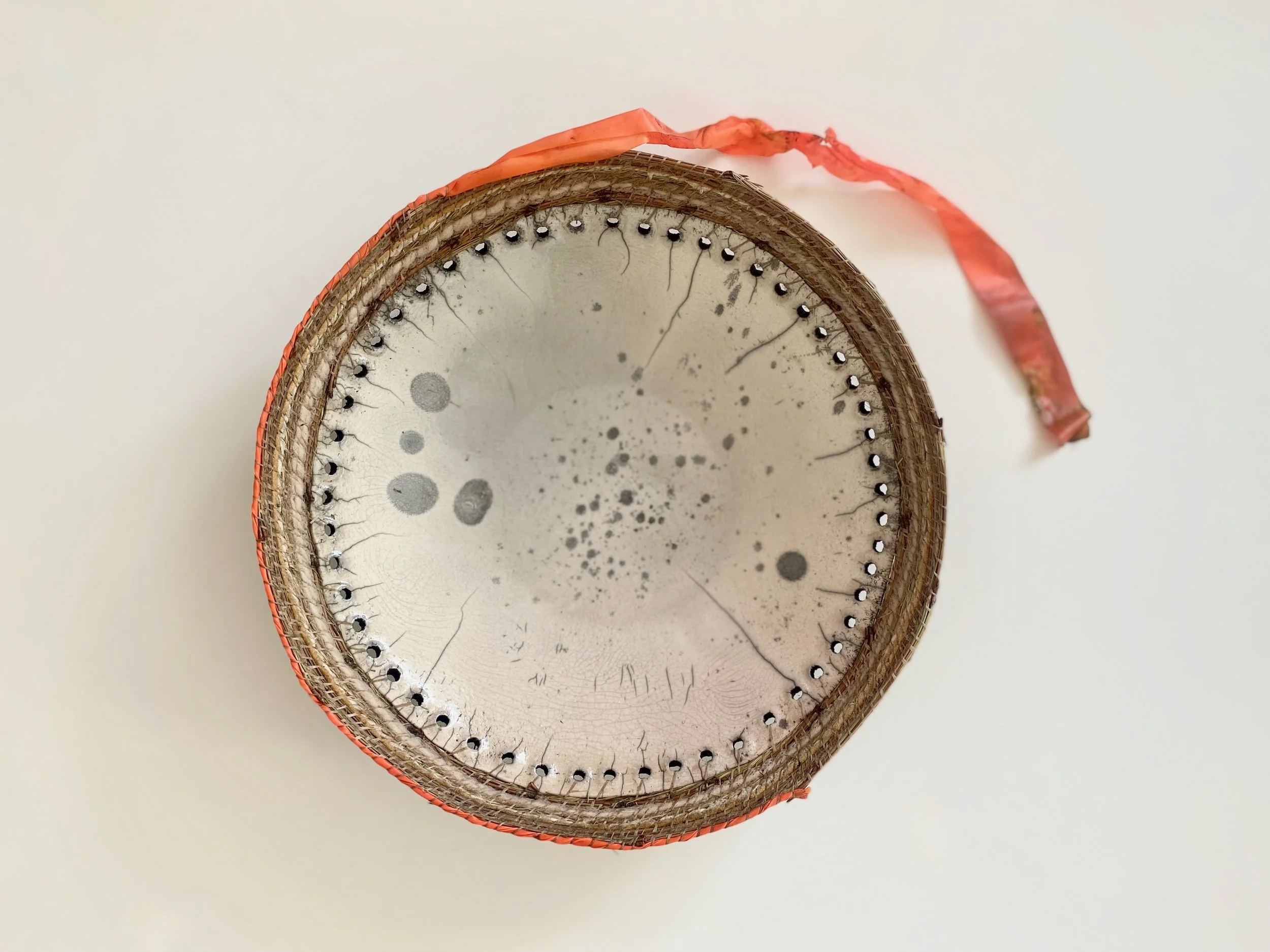
Forest Basket, Lara Felsing, 2024.
rooted with intention
Plant harvesting is central to Lara's practice, giving viewers a grounded representation of human impact. Take the piece Forest Basket (2024), for example. The striking orange flagging tape catches your eye first, intertwined with something so cherished by Indigenous and Métis peoples: the braid. Lara’s anecdotes for Shallow Breaths heavily revolve around the wildfires, smoke inhalation, and evacuations her family and communities experience. Her works included in this collection live in a constant state of teetering on the divide between cohabitation and displacement - a core feeling that Indigenous peoples know all too well.
In the work Forest Basket, the bright plastic feels abrupt at first, but after mere seconds of observing the work, it becomes dreadfully familiar. Everyone has seen something so similar before. A tag on a tree, tied so aggressively around it; it is no bow on a present, and neither isthis piece. It announces itself at full volume, refusing the misplacement to be overlooked. Still, the basket integrates it seamlessly, even as it remains materially fractured.
Shallow Breaths is filled with organic, harvested, and repurposed media transformed into biodegradable textiles and objects, as if each work becomes both an offering of gratitude and, in some cases, criticism. Many of Lara’s compositions feature oversaturated colour that interrupts natural stains and haze-washed earth tones, as seen in Mother and Daughter (2024).
Similar nods to disruption also appear in Wild Fire Country (2026), where license plates offer a reflective response to Alberta's new "Strong and Free" plates, which previously used the historical slogan "Wild Rose Country." It is the only entirely non-natural item included in the Shallow Breaths exhibition. It draws our attention to second-hand fabrics dyed with medicinal plants such as sweetgrass, spruce, fireweed, sage, and pine. Another interesting consideration for this exhibition is the exploration of scent, a rare instance in the arts. There is a noticeable juxtaposition of gathered elements against white gallery walls. Yet, it draws observers in, especially those who can pick up the lingering fragrances from the earth-based materials used. One can only imagine how Lara's creative space must smell while she crafts these fabric-scapes. Even the theme of Shallow Breaths activates the tingly sensation in your sinuses as they remember the comfort of a campfire or the soiled odour of a red-smoke-muted sky over 30,000 hectares in a valley.
Lara’s work gathers beauty and grief into the same breath, asking us as observers to notice the heavy weight the land is carrying on our behalf.
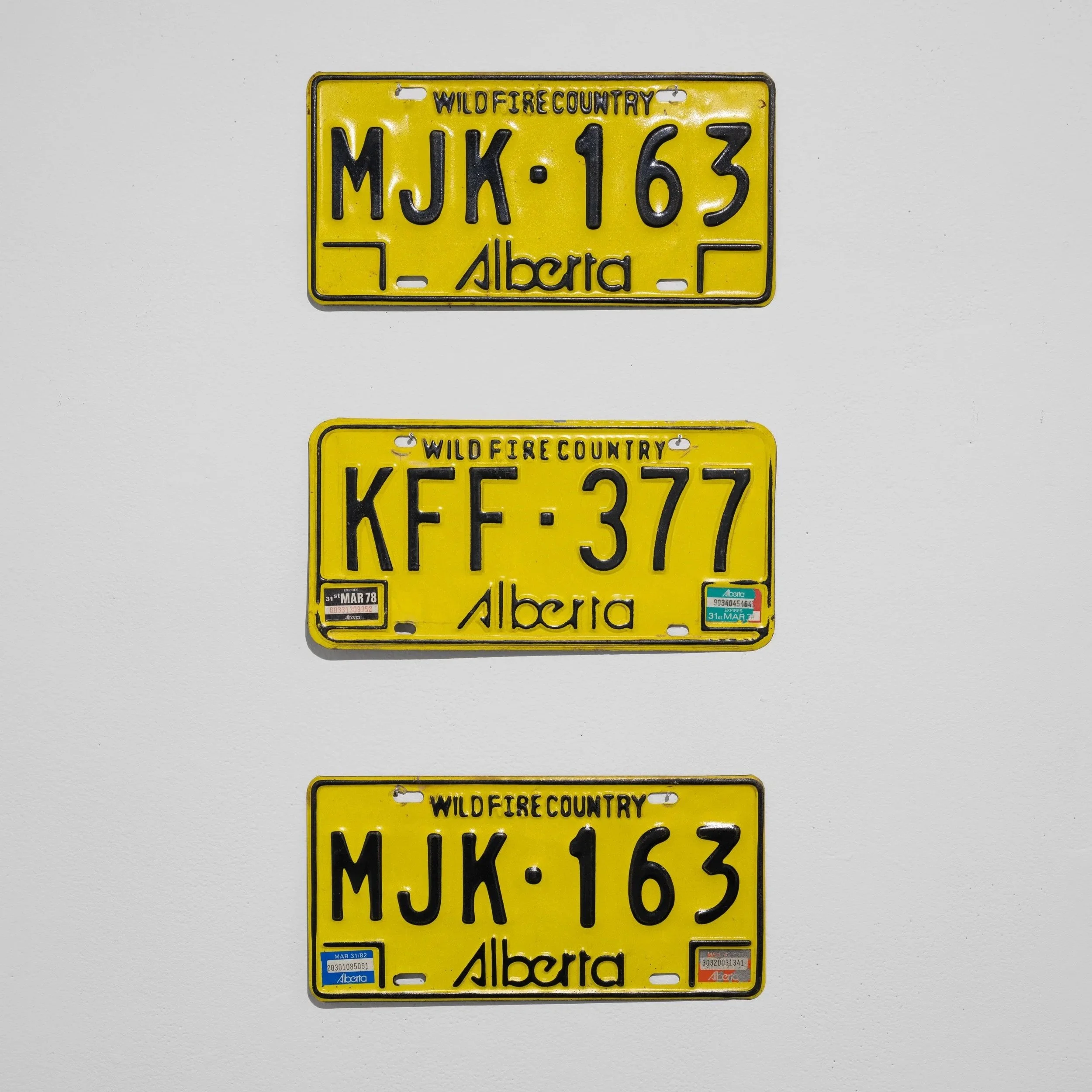
Wild Fire Country, Lara Felsing, install view, Main Gallery, 2026.
breathing with Her
Thousands of fires occur, burning millions of hectares each year in Canada. Their impact gives us visible disruption in views we admire, and for many, it’s a temporary recognition that stays in rearview mirrors as we drive onward to our next destinations - what Lara introduces us to are new perspectives and messaging about the ecological crisis we all face without presenting the works as destructive or abrasive. Instead, she stitches together expansive inheritances of reality through disruption, responsibility and balance. This is her holisticized gift unified through her colour theory, harvested practices, and applications of craftsmanship, and we have her to thank for the lesson, the reminder that the air breathed. At the same time, gathering is still shared in studio spaces, as it has always been, and will continue to be because attention is the true beginning of reciprocity.
Aly K. Benson (AKB) is a biracial Cree writer, strategist, and multimedia artist currently residing on the ancestral land of the Syilx/Okanagan peoples. With a Bachelor of Arts in Western Art History and a minor in Anthropology, AKB has published over 40 works in recent years. They were also exhibited at the Kelowna Community Theatre (April-May 2024) with their display of “Our Cabin In The Woods” and made the shortlist for the 2024 UBC Short Story Contest.